Merry Christmas
Meaning
The traditional greeting at Christmas - very commonly used on Christmas cards.
Origin
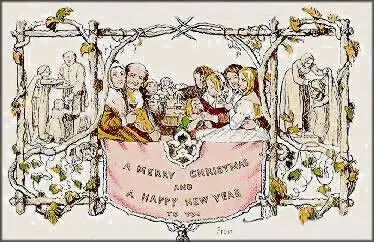 "A Merry Christmas and a Happy New Year to You"
was the verse that was shown on the first commercially available
Christmas card in 1843. Christmases has been merry long before that
though. The use of 'Merry Christmas' as a seasonal salutation dates back
to at least 1565, when it appeared in The Hereford Municipal Manuscript:
"A Merry Christmas and a Happy New Year to You"
was the verse that was shown on the first commercially available
Christmas card in 1843. Christmases has been merry long before that
though. The use of 'Merry Christmas' as a seasonal salutation dates back
to at least 1565, when it appeared in The Hereford Municipal Manuscript:"And thus I comytt you to god, who send you a mery Christmas & many."
1843 was also the date of the publication of Charles Dickens' Christmas Carol
and it was around that time, in the early part of the reign of Queen
Victoria, that Christmas as we now know it was largely invented. The
word merry was then beginning to take on its current meaning of 'jovial,
and outgoing' (and, let's face it, probably mildly intoxicated). Prior
to that, in the times when other 'merry' phrases were coined, for
example, make merry (circa 1300), Merry England (circa 1400) and the merry month of May (1560s), merry had a different meaning, i.e. 'pleasant, peaceful and agreeable'.
That change in meaning is apparently viewed
with disfavour by Queen Elizabeth II, who wishes her subjects a 'happy'
rather than 'merry' Christmas in her annual Christmas broadcasts. The
idea of a modern-day merry England is presumably unwelcome at the
palace.
The best-known allusion to merriment at Christmas is the English carol God Rest Ye Merry, Gentlemen. The source of this piece isn't known. It was first published in William Sandys' Christmas Carols Ancient and Modern
in 1833, although versions of it probably existed as a folk-song and
tune well before that but weren't written down. Sir Thomas Elyot, lists
the phrase 'rest you merry' in his Dictionary in
1548:
"Aye, bee thou gladde: or joyful, as the vulgare people saie Reste you mery."
It is often assumed that the carol's lyric
portrays the wish that jovial gentlemen might enjoy repose and
tranquility. The punctuation of the song suggests otherwise though -
it's 'God rest ye merry, gentlemen', not 'God rest ye, merry gentlemen'.
In this context 'to rest' doesn't mean 'to repose' but 'to keep, or
remain as you are' - like the 'rest' in 'rest assured'.
'Rest ye merry' means 'remain peacefully
content' and the carol contains the wish that God should grant that favor to gentlemen (gentlewomen were presumably busy in the kitchen).
It isn't the 'rest' that is being given but the 'merry'. Anyone
misreading that comma is in good company though. God Rest Ye Merry, Gentlemen was the carol that Dickens was referring to in A Christmas Carol:
"The owner of one scant young nose, gnawed and mumbled by the hungry cold as bones are gnawed by dogs, stooped down at Scrooge's keyhole to regale him with a Christmas carol: but at the first sound ofGod bless you, merry gentleman!
May nothing you dismay!Scrooge seized the ruler with such energy of action that the singer fled in terror."
